Following up from our meeting yesterday.
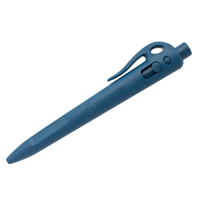
After receiving sample pens from yourselves I had some of our staff put the pens through their paces, The Super XP Cryo pen was issued to one of our very cold Deli department. Mark certainly went that extra mile to test your pen, He did the following things over a six day period:
· Allowed it to write on paper with powder residue on it such as flour and spices
All of this happened in an area which is constantly below 4°C, I taken the Cryo XP pen off Mark and passed it on to one of our vessel minders to trial it in a warm-hot working area (Cooking), Just to make it clear Mark was not at all happy about me taking the pen due to how good he found it.
I will update you next week to conclude our trials.
From:
Sent: 01 October 2011 03:40
To: Sean R. Smith
Subject: X-ray & Metal detection tests
Hi Sean
Just a quick update I did some more testing this week on the x-rayable & metal detectable products. I managed to test the x-rayable bandaid in the glass line x-ray & found that it rejected it 100% of the time. The three metallic strips within the bandaid were very clear on the machine, although the remainder of the bandaid was invisible on the image. This is obviously because the plastic is so thin & light weight. The x-ray was playing
up, so I couldn't spend any more time on it (hopefully more testing next week).
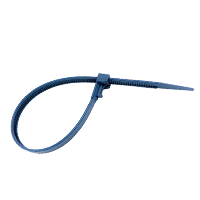
I then took the various samples -pen, bandaid, bag tag, cable tie, hairnet & glove to one of our metal detectors & ran them all through the machine. (Safeline Profile metal detector).
The results were stunning. All samples were 100% detected & rejected- even the tiny little bandaid. The indicator on the screen of the detector went from green to full red bars (off the scale) showing me that it was very easily seen by the machine.
I'll keep in touch with further developments
Material Specification
Please
email
Angela.Musson@detectamet.com for all technical data sheets
required.
What is the
answer to the question:
"How
detectable are Detectamet products?"
Detectamet
products are made from various non metallic materials (materials
that offer the best capabilities for food applications that
cannot always use a metal alternative), most Detectamet products
are made with a proportion of a metallic magnetic trace element
which is present through out the whole object, this is at a size
and concentration that allows a homogeneous flow throughout,
ensuring that all parts are potentially detectable.
Other
products have a metallic strip etc bound to the product. These
products are not detectable throughout.
Detectamet
products are all detectable - but there will be a cut off point.
This will not be systematic for all customers and indeed for all
machines/lines or sites.
There is no
100% guarantee of zero risk with any detectable products.
Even metal
- have you ever considered why small pieces of metal are able to
get into production lines?
There will
always be a limit
as to at what point the Detectamet material (or
any detectable material) will stop being detected!
This point will generally be when the metal content in the
object is smaller than the settings you are using. At
this point any metal foreign object will pass through
your system. Metal detection systems are a safeguard to a
point.
Metal
detection is not a precise science. Machines may be very
accurate, high tech and high specification instruments but there
are many variable's to consider:
Type of food or product
Packaging
Speed and orientation of the metal
Detector settings
Sensitivity and age, to
name the most common ones!
Contrary to
the rule - many Detectamet products will be detected in general
better within a
wet
environment rather than
dry -
but will achieve good results to implement into HACCP for all
areas.
Ask yourself these questions:
What do you
have the metal detector set at? Which areas have you tested in
WET or DRY?
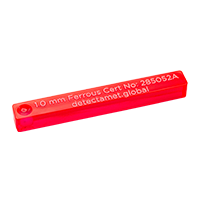
Ferrous ?
Non Ferrous
?
Stainless
Steel ?
What was
the smallest piece detected?
Lost or
found?
Ask
yourself this important question : By what percentage am I now
safeguarding my customers? - If you have a non metal detectable
pen you have 100% chance of facing an issue caused by the
potential of a lost pen. If you have a Detectamet pen which can
detect to a piece as small as 5mm then you have a 95%
chance that lost pen will be found.
Remember
that Detectamet products show that you are using all due
diligence, and you have taken the best precautions available.
We strongly
advise that you always carry out in house tests on all the
Detectamet products. For more help and information please
contact our Technical Sales at
sales@detectamet.com
for more information/test results achieved by Detectamet, Data
Sheets etc.
Material Specification :
Please
email
Angela.Musson@detectamet.com for all technical data sheets
required.
Many people think of magnetism as a property of
metal, particularly iron, since common household magnets are
made from iron. Electrical currents are actually the force
behind
magnetic
fields, which form as
electrical charges move around. On a large scale like an
electromagnet,
the
magnetic field is created by passing current
through wires. In the case of a household magnet, the field is
created by the movements of electrons in their electronic
orbits.
An electromagnet works on the
principle that an electric current not only allows electrons to
flow in a circuit, but also generates a small
magnetic field. When a wire
carrying electricity is coiled, the magnetic field becomes even
stronger. Iron or steel objects surrounded by this coiled
electric wire also become magnetized. This combination of
electronic energy, coiled wiring and conductive metal object
forms the basis of an electromagnet.
The most commonly used metal
detector in food production is the Balanced 3 Coil Detector. The
electric current is passed through the wire coil (transmitter
coil) surrounding an aperture through which the food passes.
The magnetic field so produced
induces a current in the wire coils (the receivers)
placed either side of the
transmitter. The presence of a piece of metal or Detectamet
product for example changes the current induced in the reciever
coils enabling detection.
This type of metal detector can
detect a range of different types of metal or objects containing
metals such as the Detectamet range of products. However the
machine must be tuned to the particular metal type and size
which is regarded as the greatest risk - hence the need to
identify the most important risks before deciding on the
necessary controls. It must be noted that the sensitivity of
this type is also affected by the type of product, moisture
content, the metal being detected, the size, shape and
orientation of the metal fragment, or Detectamet product, even
the position within the product.
Recent advances in this type of
machine has been in the development of variable frequency
instruments, selecting the optimum detection frequency for the
metal to be detected.
There are some simple steps you
can take to increase the detection of Detectamet products -
These adjustments will not change your settings - We only advise
these to customers who may be experiencing difficulties in
detecting Detectamet products in trials. Please call us for more
information.
The other type of metal detector
used in the food industry is the "Ferrous in Foil" or Magnetic
Field system. This system is simple to set up, having just one
control to adjust sensativity. The field is provided by
permanent magnets and a piece of metal passing through the field
induced a current in the wire coils surrounding the food
package.
This type of machine is incapable
of detecting large pieces of non-ferrous or stainless metals.
Please advise us if you are using
this machiine as it may be able to detect cerrtain Detectamet
products.
The science
behind Metal Detection was first discovered over 100 years ago
and was published by James Clerk Maxwell.
Maxwell was
a theoretical physicist, he explored theories on how the natural
world works using mathematical equations. In 1873 he published a
set of equations that described how electricity and magnetism
are the same thing.
15 years
later it was proved in an experiment that his theory was
correct.
This was
carried out by Heinrich Hertz.
Today we
still use the term "Hertz" to describe the frequency, or speed,
at which an electromagnetic wave is generated.
The
discovery by Maxwell means that light, radio waves, magnetic
waves, microwaves, X rays and many other forms of energy can be
created with the use of electricity.
It is this
scientific understanding of the nature of electricity and
magnetism which has allowed us to build all sorts of detectors.
Detectamet products are suitable
for use with magnets which are found on many production lines.
Magnets are used for the removal of ferrous metal contaminants.
Ceramic permanent magnets are used to remove objects such as
nuts and bolts and powerful earth magnets are used to remove
small items such as rust particles. Magnets are arranged in a
variety of ways - depending on the food type, moisture content
of a product, whether it is in a pipe or loose on a conveyor.
If experiencing any difficulties
in detecting Detectamet products by metal detection systems or
X-Ray, we always recommend you try a magnet test. This is a sure
sign that our product is detectable. We can then begin to look
at finding a solution to ensure our product is picked up in your
system. It is very often something quite simple!
Manual inspection should not be
forgotten - All detectable products come in bright blue as
standard, but are available in a range of high visibility
colours not commonly found in food products or our colour coding
can be used to identify areas of high risk or shift patterns.
For extra traceability Detectamet
can code many items unique to your factory requirements.